The Scandinavian Railroad
By Nick Demuth | Murray County Historical Society
The lifeblood of many prairie towns in Minnesota, and much of the Midwest in general, was the railroad.
Following the Civil War and the forceful expulsion of the Native Americans from Minnesota shortly after, the land that would become Murray County was opened up for settlement through the Homestead Act, which granted a ¼ section per person who lived on the land and improved it for five continuous years.
The railroad was instrumental in delivering those homesteaders to those newly available lands. Often times, the railroad companies themselves were benefits of free land as well through land grants. Railroad companies who received federal land grants received alternating sections of land in strips stretching 10 to 20 miles on either side of the tracks.
A railroad company doesn’t make money by building a railroad; it requires ticket sales and usage, in the form of passenger, livestock, or freight, to make money. And you can’t have any of that without people around who need to use your railroad.
As a result, the railroad companies would then either sell their granted land to speculators or directly to individuals to ensure a population who would need to rely on them for their livelihood.
How Railroads Shaped Prairie Towns
As the railroads expanded, towns sprung up along the way. By virtue of being established by the railroads, the towns often times lived or died by the economic fortunes of the railroad.
Many are the small railroad towns across the Midwest that lost their economic driver once the railroad pulled up its tracks and left town for good.
In the same vein, towns that already existed needed the railroad to come through if they had any hope of remaining an economic leader.
As evidence, look no further than the relationship between Currie and Slayton in the late 1880s and 1890s.
Despite being an older town by nearly a decade, Slayton’s population exploded relative to Currie’s, largely due to the ability of the railroad to directly deliver goods and people to the town.
If Currie hoped to compete with Slayton, they would have to have a railroad of their own.
Bringing the Railroad to Currie
And get a railroad they would.
In 1882, a group of businessmen from all over Southwest Minnesota met in Currie to discuss forming a company that would build and operate a railroad line from Yellow Medicine County or Redwood County down through Nobles County.
This endeavor would evidently fail as no such line ever existed.
Another proposed railroad envisioned a line running from Hutchinson, MN southwest to Luverne, MN, which would have gone through Murray County in the Dovray area. This also never happened.
Eventually, in 1899, the Des Moines Valley Railway Company of Minnesota was formed by local investors to build a branch line from Bingham Lake over to Currie, going through several previously established towns and linking them to the rest of the world.
The track itself was built in 1899, although the line would not become active until the summer of 1900.
The first train arrived May 22, 1900, connecting Currie with the rest of the world.
Almost immediately there was hope that the line would continue west. Rumors abounded that the line would soon be expanded to Tyler or Pipestone.
However, for the time being, Currie would remain the end of the line.
Northwestern Murray County’s Railroad Dream
However, there was one group who would continue to work hard and fight for continuing the railroad line west; that was a group of investors from the Current Lake area.
If a farmer from the Current Lake area wanted to ship their livestock out on the railroad, the closest depot was either Ruthton or Balaton, which were roughly half the distance to Lake Wilson.
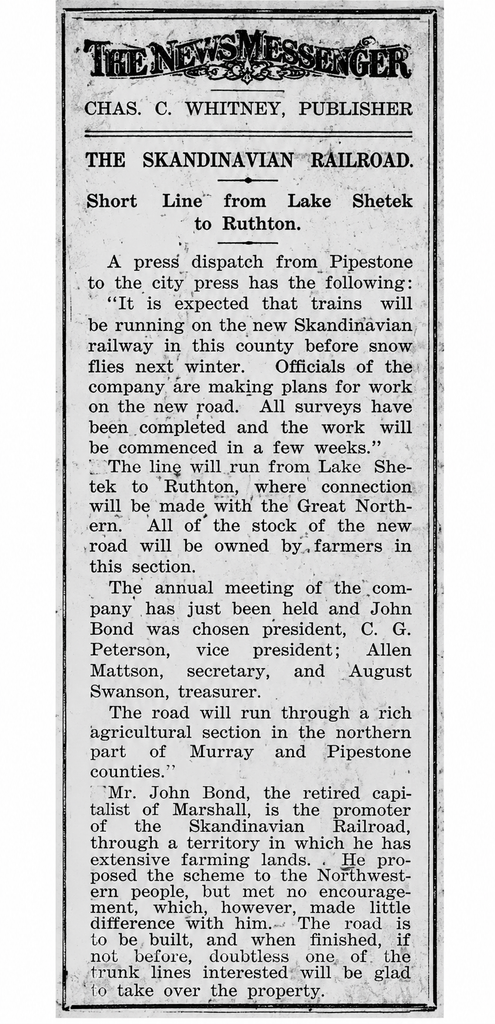
Farmers in the Northwest section of Murray County believed they were underserved by railroad companies, and after failing to convince the Great Northern Railroad to extend track into Murray County, a group of investors set out to build their own railroad connecting Ruthton to Lake Shetek.
The Scandinavian Railroad Company Is Formed
On August 19th, 1911, a group of farmers met at the Current Lake Creamery building and drew up articles of incorporation for the Scandinavian Railroad Company.
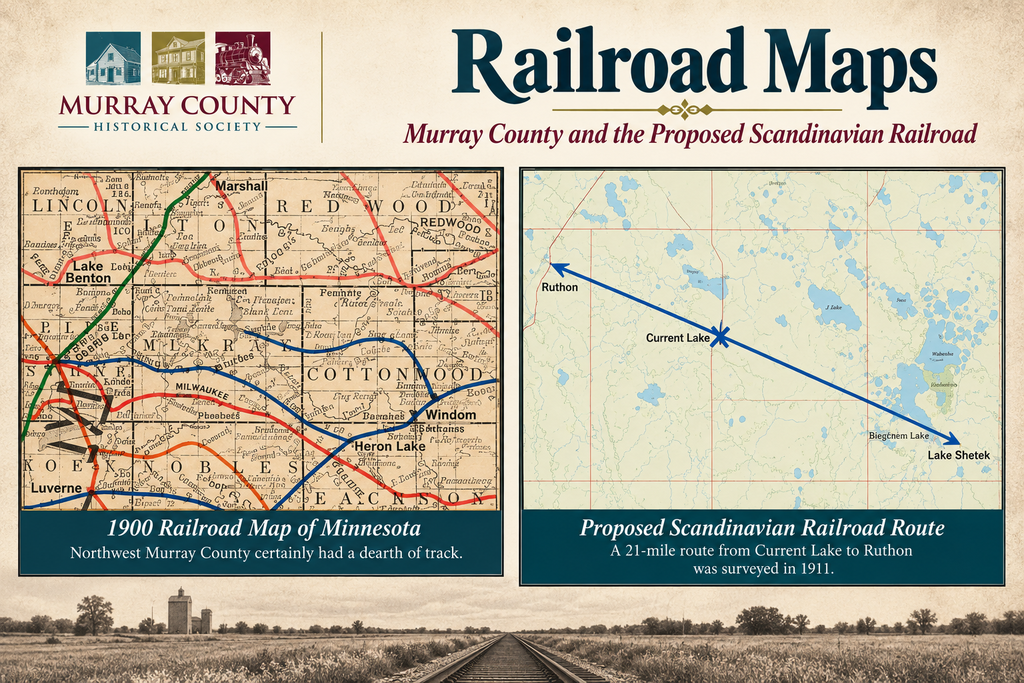
The purpose of the company was that of “locating, establishing, building, equipping and operating a railroad,” which was originally billed as going from Valhalla Island to Ruthton, with a planned stop at the Current Lake Creamery.
Having a railroad on your front step as a creamery operation would have connected them with the world and made it much easier and cheaper to ship and receive products.
On the board of directors for the corporation were C. G. Peterson, Andrew Ryberg, August Swanson, James Hall, S. M. Likness, Ludvig Larson, and E. O. Peterson.
Many of the investors involved with the plot owned land or farmed in the vicinity of where the planned railroad would have went, and would have been a financial boon to them, so it is no surprise they were on board with the plan.
John Bond was voted the president, and although the company was supposed to operate in Murray and Pipestone counties, the paperwork for incorporating was filed in Marshall.
Bond was the main proponent of the railroad and worked hard to convince people to buy in.
The stock would be sold to farmers and owned wholly by those who lived along the route.
According to the press, farmers were so eager for the line that they donated land for right-of-way purposes.
Surveying the Proposed Railroad
The group got as far as surveying routes and holding bonding votes.
In November of 1911, it was reported in the Pipestone County Star that an engineer from Minneapolis, John Westerdahl, had begun surveying potential routes for the railroad.
Three potential routes from the Current Lake Creamery to Ruthton were surveyed.
Subsequently there were bonding bills for $14,000 and $16,000 in Skandia and Ellsborough townships meant to help pay for the railroad.
The promoter John Bond was cited as being optimistic that the railroad would happen, however, the bond in Ellsborough township was defeated and the short-lived dream evidently died.
The Scandinavian Railroad Company fails to appear in newspaper reports after.
The following year in early 1913 the Scandinavian Railroad Company met with the Omaha Road railroad company and sold them the right of way.
Despite now owning the right of way and the surveys that had been done, the Omaha Road did not pursue building the line, seeing little profit in it.
A Changing Era in Transportation
This group of investors couldn’t have known it at the time, but their endeavor was almost destined to fail.
By the 1910s the automobile craze was beginning to infect the nation, and rural Minnesota was not immune.
Cars provided literal mobility to anywhere, and did not require preexisting tracks or a rigid uncompromising timetable.
Just a few years later in 1928 passenger services had begun to be cut on the Currie branch line.
As roads improved in the 1920s, the trucking industry began to emerge, and freight hauling also began to decline.
Even if the proposed line had been built, it is doubtful it would have been prosperous for long.
Article by Nick Demuth, Murray County Historical Society. Originally published in the Fall 2026 quarterly newsletter.